Zou Zou Coffee’s inventor and founder, Joseph Atallah is from the small village of Kousba northern Lebanon. He has a Bachelor of Science majoring in Organic Chemistry and a Graduate Diploma in Food Science.
Nothing makes Joseph happier than getting to talk about his love of coffee, food and science. Here he shows how the chemical composition of water can change the taste, feel and structure of your coffee.
Okay, over to Joseph…
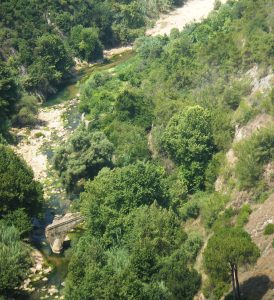
A limestone rock valley and river near the Jeita Grotto in Lebanon. Photo by Freedom’s Falcon used under Wikimedia Creative Commons license.
Lebanon and its hard water
The water available in Lebanon, not imported bottled water e.g. Perrier, is natural stream water. The water originates from the mountains above Bsharri and Jezzine and runs through crevices and ravines in the countryside and over limestone rocks.
Limestone rock is made up mostly of calcium carbonate. It also has magnesium carbonate and can include a range of other components.
As water comes in contact with limestone rocks, magnesium and calcium salts dissolve in the water creating calcium and magnesium ions. The ionised water is called ‘hard water’.
Lebanese hard water is different from what’s found in most big cities and towns. For example, Sydney collects rain water that comes in contact with sandstone rocks. Water like Sydney’s, with a lower level of ionisation, is called ‘soft water’.
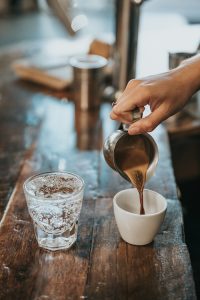
Photo by Nathan Dumlao on Unsplash
Making coffee from hard water
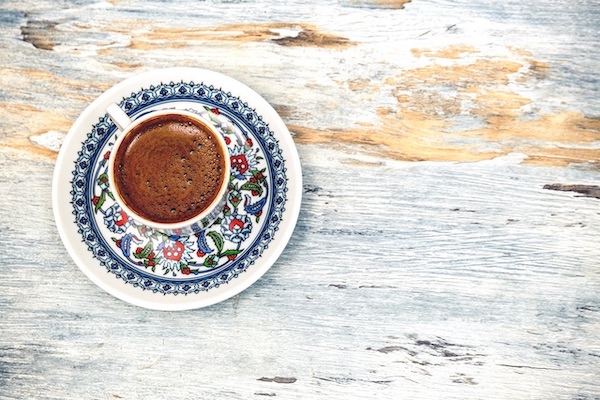
When you add coffee to water, as you do to make Arabic coffee, also called Greek or Turkish coffee, and you heat the mixture, many complex reactions take place. It is these reactions that create the smooth mouthfeel, full body, aroma and flavour of Arabic coffee that we know and love.
Traditionally, Arabic coffee is made in a raqwa or copper pot over a flame, on a stovetop or in hot sand. With Arabic, Greek and Turkish coffee, you grind the coffee beans very fine and the fine particles of coffee are mixed in with the water.
Here’s a breakdown of these reactions
- Hard water has more calcium and magnesium salts dissolved in the water, which become ions. These ions form carbon dioxide when they react with water. The harder the water, the more carbon dioxide.
- During heating, carbon dioxide, nitrogen and oxygen in the water start to bubble. The oxygen and nitrogen bubbles leave and go back into the air. The tiny carbon dioxide bubbles gather around the fine coffee grounds.
- While heating, calcium ions combine with the coffee’s organic acids and flavour compounds. This process is what creates a velvety mouthfeel and the rich flavour profile. The magnesium ions draw out the fragrant oils from the coffee grounds that enhances the aroma.
- The calcium and magnesium ions also neutralise the acids in the coffee. This process creates even more carbon dioxide bubbles.
- As the temperature of the mixture increases from 70 to 85 degrees Celsius, water bubbles replace the tiny carbon dioxide bubbles and push them away from the coffee grounds.
- The free tiny carbon dioxide bubbles float around in the heating water, and begin floating to the top. The coffee oils and proteins sit at the top of the coffee mixture and capture the carbon dioxide bubbles, which forms the crema.
- When the temperature reaches 90 to 96 degrees Celsius, the water bubbles around the fine coffee grounds thicken and expand. This causes the coffee to start rising, which is known as the ‘lift’. The lift happens only moments before the mixture boils.
- As the water begins to boil, the water bubbles get larger and and the coffee lifts. Unless you quickly take the raqwa off the heat, you can easily make a mess as the coffee gushes over the top of the raqwa. It’s likely that the designated coffee makers in any group have most have made this mistake often.
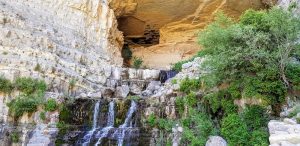
Afqa Grotto in the Mount Lebanon range in the Byblos District with water running over limestone rocks. Photo by Disdero used under Wikimedia Creative Commons license.
Harder water, better coffee
The hard water in Lebanon influences the coffee in a number of ways. There is more calcium and magnesium in the water, which enhances the fragrance and flavour of the coffee, and produces a velvety mouthfeel. Also, the lift in the Arabic coffee is stronger and rises quicker than with soft water.
As the designated coffee maker in my family, I have been in trouble many times for making a mess. Can you imagine, if you tell your mother “Mum, it’s not my fault, the water was too hard”? I know what my mother would say; roll her eyes and call me “Majdoob” (crazy idiot).
At Zou Zou Coffee we know about making Arabic coffee and how hard it can be to get it right. We’ve designed an easy-to-use, automatic Arabic coffee machine that makes from 1 to 10 cups. With just a press of a button, the perfect coffee will land into the waiting raqwa every time – no mess, no fuss.

Photo by Merve Özcan on Pexels.